As medical marijuana laws continue evolving across the United States, many Florida patients are asking the same question: Can you legally fly with medical marijuana after the latest TSA update?
In 2026, the Transportation Security Administration (TSA) updated its public guidance regarding medical marijuana and airport screening procedures. For the millions of patients enrolled in Florida’s medical marijuana program, from Naples and Fort Myers to Jacksonville, Sarasota, St. Petersburg, Melbourne, and Hialeah, understanding what this update does and does not change is essential before flying with medical marijuana.
This article breaks down the 2026 TSA medical marijuana update in detail, explains what it means specifically for Florida medical marijuana patients, and outlines the practical precautions every cannabis patient should take before flying.
What Did TSA Change About Medical Marijuana?
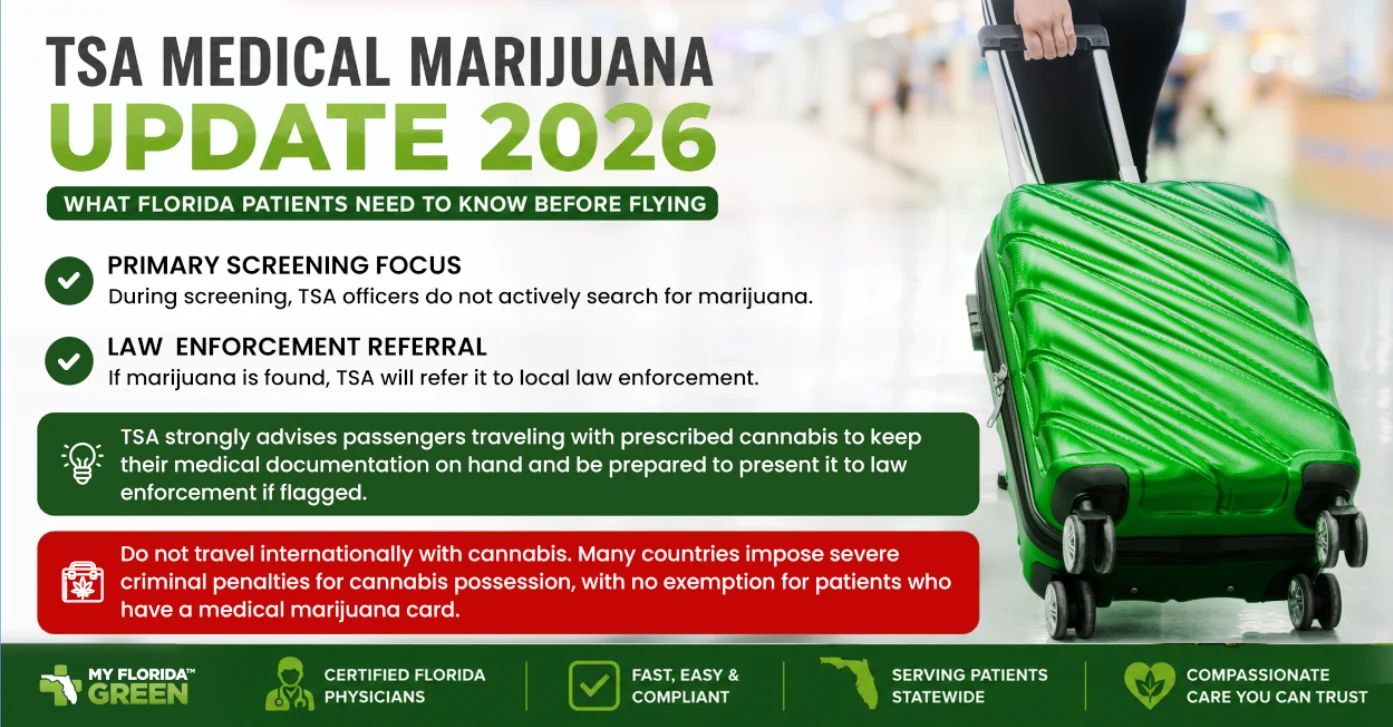
In 2026, the TSA updated its official public guidance to make one thing clear: screening officers are there to identify aviation security threats, not to look for cannabis products in passengers’ bags. This shift in TSA cannabis policy is worth understanding for Florida patients who have spent years nervously navigating Florida cannabis laws. Under the updated TSA medical marijuana update guidance, the following principles now apply:
- TSA screening officers do not specifically search for marijuana during security screenings.
- If cannabis is discovered incidentally during a security scan, officers may still refer the matter to local law enforcement.
- Final discretion on how a discovery is handled remains with TSA officers and airport authorities on the ground.
For patients flying with medical marijuana in Florida, this shift in emphasis is significant. It signals that the TSA is no longer functioning as a primary enforcement agency for cannabis possession but it does not provide legal protection or immunity for patients carrying cannabis through airport security. However, patients should understand that marijuana remains federally restricted, even in states with legal medical cannabis.

Does the TSA Update Mean Medical Marijuana Is Federally Legal?
The 2026 TSA medical marijuana update does not legalize cannabis at the federal level. Marijuana remains a Schedule I controlled substance under federal law, and airports and airline operations fall under federal jurisdiction regardless of the state in which they are located. Florida’s regulated medical marijuana program operates under state law, not federal law, and state-level protections do not extend to federally regulated spaces such as airports, aircraft, and the airspace between states. The updated TSA cannabis policy means:
- Crossing state lines with marijuana technically remains federally prohibited
- TSA may still involve airport police
- Airport policies can vary depending on the state and airport
Updated Florida MMJ travel rules simply signal that the TSA is not functioning as a primary marijuana enforcement agency.
What Florida Medical Marijuana Patients Should Know Before Flying With Medical Marijuana
Patients flying with medical marijuana in Florida should understand that enforcement under the updated TSA cannabis policy varies depending on several factors. The TSA medical marijuana update does not create uniform outcomes; how a situation is handled depends on the airport, the officer, the destination state, and the nature of the products being carried. Here is what every Naples medical marijuana doctor should explain to their patients:
-
Smaller Amounts Attract Less Scrutiny Under TSA Cannabis Policy:
Under the updated TSA medical marijuana update, enforcement discretion tends to favor patients carrying small, personal-use quantities of cannabis. Travelers flying with medical marijuana in modest amounts consistent with genuine medical needs are significantly less likely to face complications than those carrying large volumes.
-
Packaging Matters:
When flying with medical marijuana, how your products are packaged matters as much as what they are. Clearly labelled, sealed pharmaceutical packaging signals legitimate medical use and is far less likely to attract concern under the current TSA cannabis policy.
-
Medical Cards May Help Contextually:
Carrying a valid Florida medical marijuana card when traveling is always advisable. Under Florida MMJ travel rules, your card confirms you are a registered patient.
-
Certain Products Draw More Attention:
Products with strong odors, loose dried flowers, and unlabeled vape cartridges consistently attract more scrutiny during TSA screening regardless of the TSA medical marijuana update.
-
International Travel Is Extremely Risky:
Florida MMJ travel rules apply only within the United States. Many countries impose severe criminal penalties for cannabis possession with no exemption for foreign medical patients. Speak to your medical marijuana doctor Florida well in advance and make alternative arrangements before any international trip.
Does a Florida Medical Marijuana Card Protect You at Airport Security?
A valid Florida medical marijuana card confirms that you are a registered patient in the state’s medical cannabis program. Having your Florida medical marijuana card accessible when traveling is still advisable. If a TSA officer or airport law enforcement officer questions you about cannabis products in your possession, being able to demonstrate that you are a registered medical marijuana patient in a state-regulated program provides important context.
However, it does not eliminate federal risk, but it may inform how officers on the ground handle a situation at their discretion.
Flying Between Legal States vs Non-Legal States
-
Intrastate vs Interstate Travel
The risk profile for cannabis travel changes meaningfully depending on whether you are flying within Florida or traveling to another state. Intrastate travel does not cross state lines, but it still takes place in federally regulated airspace, and federal jurisdiction applies throughout that airspace.
Interstate travel, flying from Florida to any other state, involves crossing state lines with cannabis, which remains technically prohibited under federal law regardless of the legal status of cannabis in both the origin and destination states.
-
Flying Between Two Legal States
Many Florida medical marijuana patients assume that flying between Florida and another state with a legal cannabis program automatically protects them. This assumption is incorrect. Airports and airlines operate under federal rather than state jurisdiction; the laws of neither the departure nor the destination state determine your legal exposure during air travel.
Patients traveling between legal states may in practice encounter fewer complications when carrying small personal-use quantities, but this situation reflects discretionary enforcement rather than legal protection.
-
Flying to States With Stricter Cannabis Laws
Patients flying from Florida to states where cannabis remains fully prohibited face the greatest risk. The destination state’s law enforcement will apply local law to any cannabis found in your possession after you land, and local authorities in restrictive states take a very different approach to medical cannabis patients from out of state.
International Travel and Medical Marijuana: A Firm Warning
International travel with cannabis products is strongly and unambiguously discouraged for all medical marijuana patients. Many countries impose severe criminal penalties for cannabis possession. A Florida medical marijuana card has no legal validity outside the United States.
Florida cannabis patients traveling internationally should make alternative arrangements for their clinical cannabis needs well in advance of departure. They should discuss it with their medical marijuana doctor Florida before traveling with cannabis.
Best Practices for Florida Medical Marijuana Patients Traveling by Air
No travel situation involving cannabis is entirely without risk under the current TSA cannabis policy. Florida medical marijuana cardholders can follow these precautions before flying:
- Travel light and travel smart. Carry only small, personal-use quantities of cannabis when flying with medical marijuana. Anything beyond genuine personal need increases your exposure under both TSA cannabis policy and the laws of your destination state.
- Keep everything in original packaging. Clearly labelled, sealed pharmaceutical packaging is your first line of credibility at security. It signals legitimate medical use and aligns with responsible Florida MMJ travel rules that every patient should follow.
- Leave loose flowers at home. Strong-odor products and loose dried flowers attract disproportionate attention at screening. Choose low-odor, discreetly packaged formats when flying with medical marijuana to minimize unnecessary scrutiny.
- Know your destination state’s cannabis laws before you book. The TSA medical marijuana update only affects what happens at the security checkpoint, it does not change the laws waiting for you when you land. Research thoroughly and adjust your plans accordingly.
- Never carry cannabis products on international flights. No Florida medical marijuana card, no TSA medical marijuana update, and no Florida MMJ travel rules offer any protection beyond US borders. The risk is severe, and the consequences in many countries are criminal.
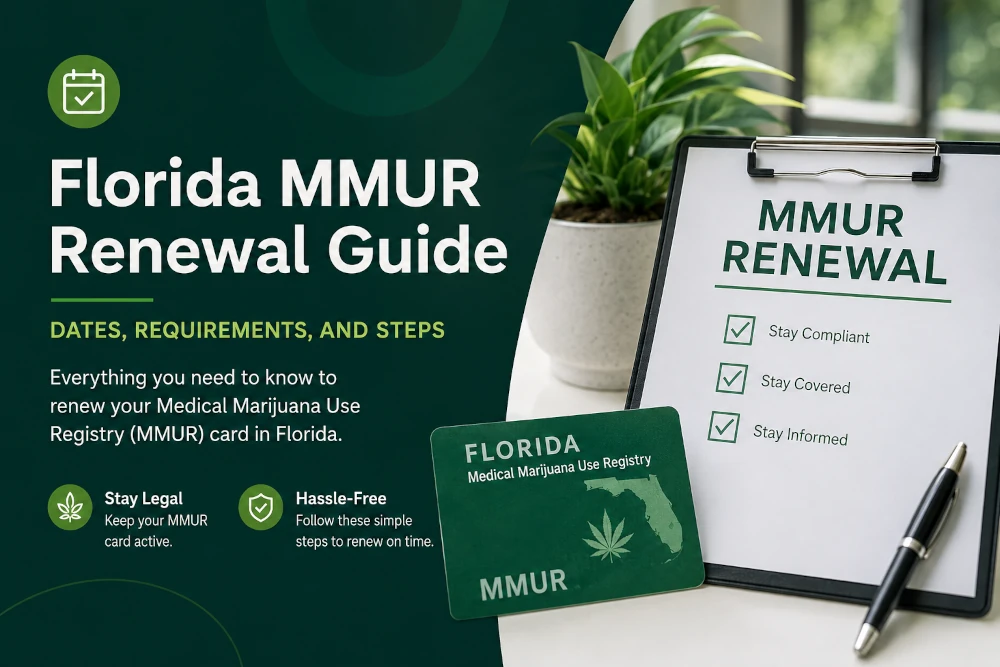
- Keep your Florida medical marijuana card on you at all times. Your clinical cannabis card provides important context if you are questioned by TSA officers. Make sure you renew your medical cannabis card on time in case you need it.
TSA Cannabis Policy and Florida’s Growing Medical Marijuana Programme
Florida’s medical marijuana program is one of the largest and fastest-growing in the United States, with thousands of patients holding a Florida medical marijuana card for qualifying conditions, including
- Chronic pain
- PTSD
- Cancer-related symptoms
- Anxiety
- Insomnia
- Neurological disorders
Understanding the TSA medical marijuana update and how it intersects with Florida MMJ travel rules is an important part of being an informed, compliant patient, particularly as more Floridians rely on clinical cannabis as part of their daily healthcare routine.
At My Florida Green, our state-licensed cannabis physicians help patients navigate Florida medical marijuana laws, compliance requirements, and safe access to physician-guided care. Whether you are a new patient or renewing your Florida medical marijuana card, our team is here to support you. We serve patients across:
- Naples
- Fort Myers
- Sarasota
- Jacksonville
- St. Petersburg
- Melbourne
- Hialeah
Speak to a medical marijuana doctor Florida at your nearest My Florida Green location today.
Summary
The 2026 TSA medical marijuana update is a meaningful step forward in how federal aviation security authorities communicate about cannabis but it is not a green light for unrestricted travel with cannabis products.
TSA has clarified that its officers are not primarily tasked with marijuana enforcement, and that when cannabis is discovered during screening, referral to local law enforcement is handled with discretion. However, marijuana remains federally restricted, and a Florida medical marijuana card does not provide legal protection in federally regulated spaces such as airports and aircraft. Florida cannabis patients traveling domestically should carry only small personal-use quantities in clearly labelled original packaging, research destination state laws thoroughly, and never attempt to travel internationally with any cannabis product.
The safest approach remains staying well-informed, exercising caution, and consulting with your medical marijuana doctor Florida if you have questions about compliance. My Florida Green’s state-licensed cannabis physicians and patient support team are available across multiple Florida locations to help patients navigate their medical marijuana approval, understand their compliance obligations, and access physician-guided cannabis care with confidence.
FAQ – Frequently Asked Questions
-
Is it legal to fly with medical marijuana in Florida?
Florida allows qualified patients to possess medical marijuana under state law, but federal rules and airport security policies still affect air travel. Patients should understand that legality becomes complicated once they enter an airport or cross state lines. Florida’s OMMU confirms patients must be registered and have a Medical Marijuana Use Registry ID card.
-
Does TSA search for marijuana?
The TSA states that its screening procedures are focused on aviation security, not actively searching for marijuana or other drugs. However, if marijuana is discovered during screening, officers may take further action based on TSA policy and applicable laws.
-
Can TSA confiscate medical marijuana?
TSA officers may refer marijuana discoveries to local law enforcement, and what happens next can depend on the airport, local laws, and the circumstances. Even with a Florida medical marijuana card, patients should be cautious because airport and federal rules may differ from state medical marijuana protections.
-
Can I travel internationally with medical marijuana?
International travel with cannabis products is strongly discouraged due to varying international drug laws. Many countries impose severe criminal penalties for cannabis possession, with no exemption for patients who have a medical marijuana card.
-
Do I need my Florida medical marijuana card while traveling?
Patients should keep their Florida medical marijuana card accessible when traveling with medical cannabis products.
About the Author
Dr. Tazeen T. Zaidi (MD) is a board-certified family physician based in Sanford, FL, with over 30 years of experience. She has been associated with providing medical marijuana evaluations as part of her practice in Florida. Dr. Zaidi is double certified in Medical Marijuana Medicine by the Society of Cannabis Clinicians and the American Academy of Cannabis Medicine. She has practiced for over 20 years and is dedicated to helping patients access safe and effective medical cannabis treatment.
Medical Disclaimer
The information provided in this video and/or article is for educational and informational purposes only and is not intended as medical advice. It should not be used as a substitute for professional medical diagnosis, treatment, or guidance from a qualified healthcare provider.
Always seek the advice of your physician or other licensed healthcare professional regarding any medical condition or treatment options. Never disregard professional medical advice or delay seeking care because of something you have read or viewed here.
Medical services, evaluations, certifications, and treatment recommendations are provided only after an individualized assessment by a licensed physician and are subject to applicable state laws and regulations.
If you experience a medical emergency, call 911 or contact your healthcare provider immediately.